 House style v2 for bhagya.cards. A calm, devotional, premium image for an Indian almanac website with a dark theme.
Mood: quiet and reverent, warm, like the hush before an evening aarti.
Light: low and warm, from diyas, brass lamps or first sunlight; soft falloff into deep shadow; gentle gold
highlights; never flash, never flat daylight.
Palette, held across the whole frame: a deep night-maroon ground (#160D0C, #1F1311) deepening to oxblood (#2B100D,
#3A1714) in the shadows; burnished gold (#E2B55E, #EDBE6E) as the main highlight; saffron (#F2A24A) only in flame,
marigold or thread; warm cream (#F3E8DF) only in cloth, paper or marble; sindoor red and leaf green as small natural
accents. No blue, teal or purple cast, no neon, no pastels, no white backgrounds.
Materials: matte handmade paper, hand-beaten brass and copper, cotton and silk, old teak, stone; fine film grain.
No drawn ornament, diagram or pattern laid over the scene; no frames, no borders.
Composition: one clear subject; generous dark negative space; the subject inside the central 70% of the frame, so it
survives a 1.91:1 crop; eye level or slightly above; shallow depth of field.
People, only when the subject needs them: Indian, in modest traditional dress, natural and unposed; hands, profiles
and backs rather than faces turned to the camera; no likeness of any real or well-known person.
Respect: a deity appears only as a temple murti or a framed traditional painting, small in the frame, garlanded,
whole and upright, never on the floor and never near footwear; one tradition's iconography per image. Do not draw any
specific yantra, and do not draw a card or any printed product.
The image carries no text, letters, numerals, logos, watermarks or signatures anywhere.
Finish: photographic realism with a fine-art feel.
SUBJECT: A home Lakshmi puja on Diwali night in a Maharashtrian home, set on a low carved teak chowrang covered with red silk. At its centre, small, garlanded with marigolds and softly out of focus, stands an upright framed traditional painting of Mahalakshmi seated on a pink lotus. Before it rest a brass kalash with mango leaves and a coconut, a brass plate of puffed rice and batasha, a few lotus flowers and rows of small clay diyas, their light warm and gold. A string of marigolds hangs above. Do not show: any yantra or geometric diagram, coins, currency or heaps of jewellery, a card or printed product, any face in close-up, rangoli patterns, any writing or symbols, footwear nearby.
FORMAT: 16:9 landscape, page hero.
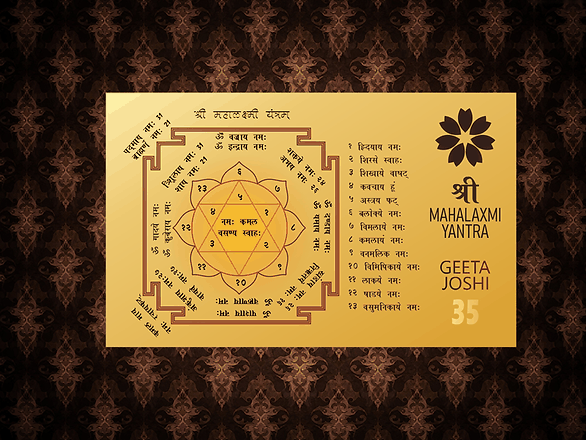
Mahalaxmi Yantra Card
Mahalakshmi Yantra is a sacred geometry symbolizing Goddess Lakshmi. In tradition, Sri Mahalakshmi Yantra is worshipped for prosperity and abundance and for the fulfillment of material desires.
The Goddess of Wealth and Abundance
Goddess Mahalakshmi symbolizes wealth, the provider of good fortune, abundance, and prosperity. The Sanskrit word Lakshya means aim or purpose, which directs us toward Mahalakshmi. Therefore, Lakshami means to drive yourself towards a goal.
Mahalakshmi is not only a companion of Lord Vishnu' but also is his energy. Lord Vishnu is the Supreme Narayan, and Mahalaxmi is endowed with six divine strengths.
When Lord Vishnu chose to incarnate on earth as an avatar Rama accompanied him as Sita. When Lord Vishnu incarnated as Krishna, Lakshmi was the Rukmini.
 House style v2 for bhagya.cards. A calm, devotional, premium image for an Indian almanac website with a dark theme.
Mood: quiet and reverent, warm, like the hush before an evening aarti.
Light: low and warm, from diyas, brass lamps or first sunlight; soft falloff into deep shadow; gentle gold
highlights; never flash, never flat daylight.
Palette, held across the whole frame: a deep night-maroon ground (#160D0C, #1F1311) deepening to oxblood (#2B100D,
#3A1714) in the shadows; burnished gold (#E2B55E, #EDBE6E) as the main highlight; saffron (#F2A24A) only in flame,
marigold or thread; warm cream (#F3E8DF) only in cloth, paper or marble; sindoor red and leaf green as small natural
accents. No blue, teal or purple cast, no neon, no pastels, no white backgrounds.
Materials: matte handmade paper, hand-beaten brass and copper, cotton and silk, old teak, stone; fine film grain.
No drawn ornament, diagram or pattern laid over the scene; no frames, no borders.
Composition: one clear subject; generous dark negative space; the subject inside the central 70% of the frame, so it
survives a 1.91:1 crop; eye level or slightly above; shallow depth of field.
People, only when the subject needs them: Indian, in modest traditional dress, natural and unposed; hands, profiles
and backs rather than faces turned to the camera; no likeness of any real or well-known person.
Respect: a deity appears only as a temple murti or a framed traditional painting, small in the frame, garlanded,
whole and upright, never on the floor and never near footwear; one tradition's iconography per image. Do not draw any
specific yantra, and do not draw a card or any printed product.
The image carries no text, letters, numerals, logos, watermarks or signatures anywhere.
Finish: photographic realism with a fine-art feel.
SUBJECT: A single pink lotus held in a pair of cupped hands, seen close, its petals half open and touched with a little kumkum and a few grains of rice, as a devotee in a red silk saree offers it in the soft light of a brass lamp. The background falls into deep maroon shadow, with the faint gold glimmer of a small brass kalash and a marigold garland out of focus. Drops of water still cling to the lotus from the temple tank. The mood is of purity and quiet offering. Do not show: any yantra or geometric diagram, a card or printed product, a deity figure or face, coins or currency, any writing or symbols, faces.
FORMAT: 4:3 landscape, inline image.
Mahalakshmi is always seen seated on a lotus. Her four hands denote the four goals of human life – dharma, artha, kama and moksha.
In popular literature, Lakshmi personifies wealth, riches, beauty, happiness, grace, charm, and splendor.
While the universe was being created, Lakshmi sprang up with the treasures from the 'Samudra Manthan' churned by devas and asuras. Samudra Manthan is seen as the churning of the ocean. She carried a lotus in her hand and is therefore called Padma Lakshmi.
According to the Saubhagya Lakshmi Upanishad, Mahalakshmi is the divine giver of boons. In tradition, she is the bestower of wealth, has a golden form, and is adorned with a garland of gold. She has a golden sheen and dwells within a lotus symbolizing purity.
The Mahalaxmi Yantra Card in Your Daily Practice
The Mahalaxmi Yantra Card carries the yantra that families keep for prosperity and fulfillment. Keep it with devotion; it is offered with love, not as a promise of a specific result.