The twenty-seven nakshatras: names, padas and stories
A nakshatra is one of 27 equal parts of the Moon's path across the sky, each 13°20′ wide. The Moon passes through all 27 in about 27⅓ days, so it stays about a day in each. The panchang names the day's nakshatra, and your janma nakshatra is the one the Moon was in when you were born.
By Yantra Guru, the Bhagya Cards editorial desk · Updated
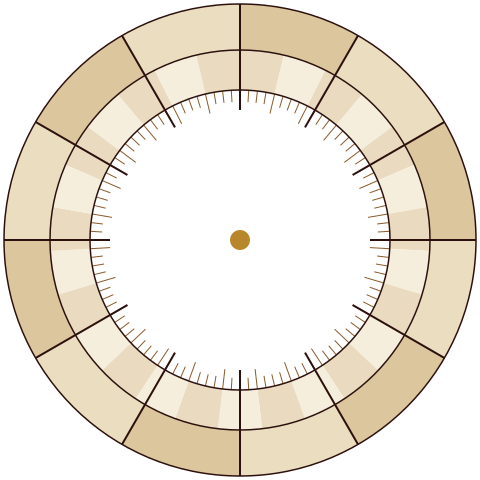
The twelve rashis and the 27 nakshatras divide the same circle of sky, and both begin together at the first point of Mesha and Ashwini. A rashi holds nine padas, two and a quarter nakshatras, so most rashi boundaries fall inside a nakshatra. The two rings share a boundary at only three points: where Revati meets Ashwini, where Ashlesha meets Magha and where Jyeshtha meets Mula.
The outer ring is the twelve rashis, the inner ring the 27 nakshatras; each tick is a pada; nine padas make a rashi
What a nakshatra is
Night after night the Moon moves east against the stars, about one nakshatra a day. The Vedas already name the nakshatras, and the panchang still keeps each day by them: the nakshatra is one of its five limbs, beside tithi, vara, yoga and karana. Today's panchang shows the day's nakshatra for your city.
Your janma nakshatra is the one the Moon was in when you were born. Families use it to choose the first syllable of a child's name and to compare kundalis before a marriage. The app's birth nakshatra tool finds yours from your date, time and place of birth.
Four padas each, nine to a rashi
Each nakshatra divides into four padas, so the 27 hold 108 padas and each rashi takes nine of them. Nine padas make two and a quarter nakshatras, so a nakshatra at a rashi's edge is shared with the next rashi: Krittika has its first pada in Mesha and the other three in Vrishabha.
Each pada has its own syllable. At the namakarana, the naming ceremony, many families choose a name that opens with the syllable of the child's janma nakshatra pada, such as Chu, Che, Cho or La for Ashwini. The app's baby names tool starts from these syllables.
Twelve months named for nakshatras
Each lunar month takes its name from the nakshatra the Moon is in, or near, at that month's full moon. So the full moon of Kartika falls in or near Krittika, and the full moon of Chaitra in or near Chitra.
The Puranic tradition counts the nakshatras as the 27 daughters of Daksha, all married to Chandra, the Moon. Chandra stayed with Rohini above the rest, the sisters complained to their father, and Daksha's curse set the Moon waning. Chandra prayed to Shiva at Prabhasa, where Somnath stands, and the curse was softened: tradition reads the Moon's phases here, waning for a fortnight and waxing again in the next.
The six Krittikas nursed the infant Kartikeya, who took six faces to be fed by all of them. Older lists count a 28th nakshatra, Abhijit, the star Vega; it has no share in the Moon's 27 equal parts.
Ashwini opens the round at the first point of Mesha, where the solar year begins in many regions. Its two stars sit close together at the head of the Ram, a fitting pair for its twin deities.
The Ashwini Kumaras are the horsemen of the Rig Veda, twins who drive their chariot ahead of the dawn. The name itself comes from ashva, the horse.
Bharani's three faint stars make a small triangle in the Ram, easy to miss beside the bright Pleiades that follow it. Its deity is Yama, keeper of dharma and guide of those who have died.
In Pitru Paksha, the fortnight kept for the ancestors, the day the Moon is in Bharani is Bharani Shraddha. Families offer water and food in the names of those they have lost.
Krittika is the Pleiades, the small misty cluster in which most eyes can count six or seven stars on a winter evening. Its deity is Agni, and Kartika, the month of lamps, takes its name from it.
The six Krittikas nursed the infant Kartikeya, who carries their name. Kartikswami darshan is kept on the full moon of Kartika when the Moon is in Krittika, and Tamil homes light lamps for Karthigai Deepam in the same season.
Older Vedic lists begin the round with Krittika, not Ashwini. Later reckonings moved the start to the point opposite Spica, the star of Chitra.
Rohini is Aldebaran, the orange-red eye of the Bull, at the tip of a V of fainter stars. Its colour is plain to see on a clear night, and the name says it.
In the Puranic tradition Rohini is the wife Chandra loved most, as the story above tells. Krishna was born, tradition holds, with the Moon in Rohini, so many families look for Rohini as well as the eighth tithi when they keep Janmashtami.
Mrigashira is the faint triangle of stars at the head of Orion, the hunter of Greek star lore. Margashirsha, the month named for it, is the one Krishna claims in the Gita: among months, he says, I am Margashirsha.
Mrigashira opens the eleven rain nakshatras that run to Swati. The Sun's entry into it is when the monsoon's first rains are expected, and farmers in Maharashtra still call those rains the Mrig.
Ardra is Betelgeuse, the red shoulder of Orion and one of the brightest stars of the winter sky. Its deity is Rudra, the Vedic deva of the storm.
The Sun's entry into Ardra, the second rain nakshatra, is when the heavier rains are expected. In Tamil Nadu it is Thiruvathirai, and Arudra Darshan honours Shiva as Nataraja, above all at Chidambaram, when the Moon is in it in the month of Margazhi.
Punarvasu is Castor and Pollux, the two bright heads of the Twins, side by side. Its deity is Aditi, the mother of the devas.
The Ramayana tells that Rama was born on the ninth tithi of Chaitra, under the nakshatra whose deity is Aditi: Punarvasu. The Sun's entry into Punarvasu, the third rain nakshatra, is when the rains are expected to settle in.
Pushya's two faint stars stand either side of the Beehive, a misty cluster that a dark sky shows to the eye alone. Its deity is Brihaspati, guru of the devas, and Pausha, the winter month, takes its name from it.
When the Moon is in Pushya on a Thursday, Guru's day, families keep Guru Pushyamrut to buy gold, open new account books or begin a study. In Tamil Nadu, Thaipusam honours Murugan with the Moon in Pushya in the month of Thai.
Ashlesha's small ring of faint stars is the head of Hydra, the water snake, the largest constellation in the sky. Indian and Greek star lore both see a serpent here: Ashlesha's deities are the Nagas, and its symbol is a serpent.
The Sun's entry into Ashlesha, the fifth rain nakshatra, falls in the heart of the monsoon.
Magha is Regulus, the bright star at the heart of the Lion, and its symbol is a royal throne. Magha, the late-winter month, takes its name from it.
Its deities are the Pitrus, the ancestors, and in Pitru Paksha the day the Moon is in Magha is kept as Magha Shraddha. The Sun's entry into Magha, the sixth rain nakshatra, is when the monsoon's later rains are expected.
Regulus lies almost exactly on the Sun's path, so the Moon sometimes passes in front of it and hides the star from view for a while.
Purva Phalguni's two stars lie in the Lion's back, and with Uttara Phalguni they make the frame of a bed: these are its front legs. Phalguna, the month of Holi, is named for the pair.
Its deity is Bhaga, the Vedic deva of each person's rightful share. The Sun's entry into Purva Phalguni, the seventh rain nakshatra, is when the late rains of the monsoon are expected.
Uttara Phalguni is Denebola, whose Arabic name means the lion's tail, and its stars are the back legs of the bed the two Phalgunis share.
Its deity, Aryaman, is the Vedic deva of friendship and hospitality, called on in the wedding rites. The Sun's entry into Uttara Phalguni, the eighth rain nakshatra, is when the late rains are expected.
Hasta is Corvus, a small group of bright stars that can be read as the fingers of an open hand. Its deity is Savitr, the Sun who rouses the day.
The Sun's stay in Hasta, the ninth rain nakshatra, is when the season's late rains are expected, and Gajachhaya yoga is reckoned with it. Samavedi families keep Shravani, the yearly renewal of the sacred thread, when the Moon is in Hasta.
The Gayatri mantra is addressed to Savitr, Hasta's deity: its words tat savitur varenyam name him.
Chitra is Spica, the blue-white star of Virgo, standing bright and alone. Its deity is Tvashtr, the craftsman of the devas, and Chaitra, the first month of the year in many calendars, takes its name from it.
The Sun's entry into Chitra, the tenth rain nakshatra, is when the monsoon's last rains are expected.
Spica sits close to the line where Kanya ends and Tula begins. The Lahiri reckoning, which this site's rashis and nakshatras use, takes this star as its reference, so it is also called Chitrapaksha.
Swati is Arcturus, the brightest star north of the celestial equator, glowing orange on spring and summer evenings. Its deity is Vayu, the wind, and its symbol a young shoot.
Swati is the last of the eleven rain nakshatras. Poets tell that a raindrop falling in Swati becomes a pearl inside an oyster, and that the chataka bird drinks no rain but Swati's.
Vishakha's two stars in Libra keep Arabic names that mean the southern and the northern claw, from a time when they were read as the Scorpion's pincers. Its deities are Indra and Agni together, and the month Vaishakha takes its name from it.
In Tamil Nadu, Vaikasi Visakam keeps the birth of Murugan, Kartikeya, on the day the Moon is in Vishakha in the month of Vaikasi.
Radha is an old name of Vishakha, so Anuradha is simply the nakshatra that follows it. Its stars are the bright arc at the Scorpion's head, and its deity is Mitra, the Vedic deva of friendship and agreements.
In Maharashtra, Jyeshtha Gauri is welcomed home on the day the Moon is in Anuradha, worshipped in Jyeshtha and sent off in Mula: three nakshatras, usually on three days in a row.
Jyeshtha is Antares, the red heart of the Scorpion, whose Greek name means rival of Mars, for its colour. Its deity is Indra, chief of the devas.
The month Jyeshtha takes its name from it. In Maharashtra, the day the Moon is in Jyeshtha is the day of the Jyeshtha Gauri puja, between her welcome in Anuradha and her farewell in Mula.
Mula is the curl of stars in the Scorpion's tail, ending in its sting low in the southern sky. Its deity is Nirriti, and its symbol is a bunch of roots tied together.
In Navratri, many homes place their books before Saraswati on the day the Moon is in Mula, her avahan, and keep them there until the Moon reaches Shravana. Mula is also the day Jyeshtha Gauri is sent off.
Purva Ashadha's two stars sit in the Archer's bow, part of the shape stargazers call the Teapot. Its deity is Apas, the waters, and with Uttara Ashadha it names Ashadha, the month of the Pandharpur wari.
In Navratri, Saraswati's puja falls on the day the Moon is in Purva Ashadha, the day after her avahan in Mula.
Uttara Ashadha follows its twin across the Archer, and its deities are the Vishvedevas, all the devas together. Between it and Shravana, older lists place Abhijit, the 28th nakshatra, whose star is Vega.
In Navratri, the day the Moon is in Uttara Ashadha is Saraswati balidan, the day of offering before her visarjan in Shravana.
Shravana is Altair and the two stars beside it, three in a row that tradition reads as the three strides of Vishnu, its deity. Shravana, the month of the Shravan Somvar vrats, takes its name from it.
When the Moon is in Shravana in that month, Rigvedi families renew the sacred thread at Shravani, and Saraswati's visarjan in Navratri falls on Shravana too. In Kerala, Onam is kept on Thiruvonam, Shravana's Malayalam name, in the month of Chingam.
Dhanishta is the small diamond of Delphinus, the Dolphin, four faint stars close together. Older texts call it Shravishtha, and Tamil and Malayalam call it Avittam.
Its deities are the eight Vasus, the devas of the elements and the lights of the sky, and its symbol is a drum or a flute.
Shatabhisha is a wide scatter of faint stars in the Water-bearer, around Sadachbia, and Marathi calls it Shatataraka, the hundred stars. Its deity is Varuna, lord of the waters.
Varuni yoga, named for Varuna, falls when Shatabhisha meets the thirteenth tithi of a waning fortnight in spring. Families keep it with a bath in a sacred river.
The two Bhadrapadas share the Great Square of Pegasus, four stars that make a wide box in the autumn sky. Purva Bhadrapada holds its western side, Markab and Scheat, the front legs of a cot.
Its deity is Aja Ekapada, the one-footed goat, a form of Rudra. With Uttara Bhadrapada it names Bhadrapada, the month of Ganesh Chaturthi.
Uttara Bhadrapada holds the Great Square's eastern side, Algenib and Alpheratz, the back legs of the cot. Its deity is Ahir Budhnya, the serpent of the deep waters in the Vedas.
All four of its padas lie in Meena, the last rashi, as do all four of Revati's after it.
Revati closes the round, and its faint star, Zeta Piscium, lies near the point where the circle ends and Ashwini begins again. Its deity is Pushan, the Vedic guardian of roads and travellers, who finds lost cattle and shows the way home.
After Revati the Moon crosses back into Ashwini and starts its round of the 27 again.
Revati's star marks the end of the sidereal circle, so in the old reckoning the Sun's crossing of it began a new solar year.
When two families compare kundalis before a marriage, guna milan looks at eight kootas drawn from the bride's and the groom's janma nakshatras and rashis. Three of the eight come straight from the nakshatra: gana (deva, manushya or rakshasa), yoni (an animal) and nadi (adi, madhya or antya). That is why each nakshatra above lists all three.
This page makes no judgement on any match. The app's guna milan tool takes the bride's and the groom's birth details.
Where traditions differ
Most lists count 27 nakshatras, and older ones add Abhijit as a 28th. Deities vary from text to text: Hasta's is Savitr or Surya, and Rohini's Brahma or Prajapati. Symbols vary too, with several each for Pushya, Jyeshtha and Purva Bhadrapada, and the Kerala list of nakshatra trees differs for seven of the 27.
The syllables for names differ by region, so a family may follow its own list. Hindi and Marathi write some names differently: शतभिषा and शततारका, मूल and मूळ.
All twenty-seven at a glance
The 27 nakshatras with their lords, the rashis of their padas and the four syllables of each
A nakshatra is one of 27 equal parts of the Moon's path across the sky, each 13°20′ wide. The Moon crosses about one a day, and the panchang names each day by the one it is in.
How do I find my janma nakshatra?
It is the nakshatra the Moon was in at the moment you were born, so it needs your date, time and place of birth. The app's birth nakshatra tool finds it for you.
What is a pada?
A pada is one quarter of a nakshatra. The 27 nakshatras hold 108 padas, nine to each rashi, and each pada has its own syllable.
How is a child's name chosen from the nakshatra?
At the namakarana, many families choose a name that begins with the syllable of the pada the Moon was in at the child's birth. The app's baby names tool starts from those syllables.
Why are there twenty-seven nakshatras, and sometimes twenty-eight?
The Moon takes about 27⅓ days to return to the same stars, so its path is divided into 27 equal parts, about one for each day. Older lists add Abhijit, the star Vega, as a 28th; it lies far north of the Moon's path and has no equal part of its own.
The day's nakshatra, in the app
The free Bhagya Card app, on your phone and on the web, shows the day's panchang for your city, nakshatra included. Its free tools include birth nakshatra, baby names and guna milan.