A rashi is one of the twelve signs of the Vedic zodiac: 30° of the sidereal circle, fixed to the stars. In India, “your rashi” usually means your Moon sign, the rashi the Moon was in at your birth. The Vedic and Western zodiacs are offset, so a Western sign and the rashi of the same name often differ.
By Yantra Guru, the Bhagya Cards editorial desk · Updated
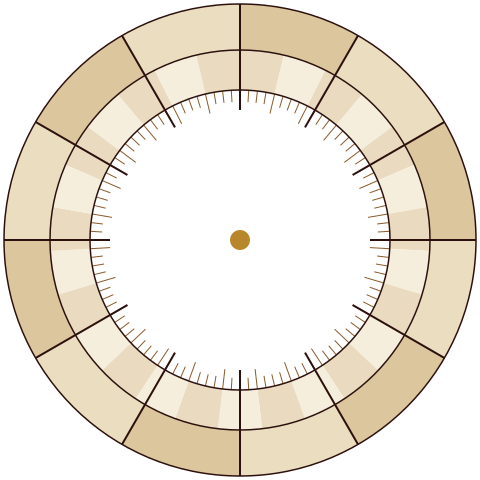
The rashis and the nakshatras divide the same circle. Cut it into twelve and you have the rashis, 30° each; cut it into 27 and you have the nakshatras, 13°20′ each. Every nakshatra has four padas, or quarters, so the circle holds 108 padas, and each rashi holds exactly nine.
Nine padas are two nakshatras and a quarter, so the borders meet only three times: where Mesha and Ashwini begin, where Simha and Magha begin, and where Dhanu and Mula begin. Everywhere else a nakshatra starts in one rashi and ends in the next, as Krittika runs from Mesha into Vrishabha. The nakshatra page reads the same circle from the other side.
The outer ring is the twelve rashis, the inner ring the 27 nakshatras; each tick is a pada, and nine padas make a rashi.
Moon sign or Sun sign: which rashi is yours
In India your rashi is your janma rashi, the sign the Moon was in at your birth. The Moon crosses a rashi in two to two and a half days, so it takes the date, time and place of birth, the three things a kundali is cast from.
A Western horoscope names the Sun's sign instead, in a zodiac that starts at the spring equinox. The equinox slips backwards against the stars while the Vedic zodiac stays with them, so on a Western sign's dates the Sun is often still in the previous rashi. How we compute explains the site's reckoning.
The Sun stays about a month in each rashi, and the moment it enters the next is a sankranti. In the solar calendars of Kerala, Tamil Nadu, Odisha, Bengal, Assam and Punjab, each sankranti opens a month.
Makar Sankranti, the Sun's entry into Makara, is kept across India: til-gul in Maharashtra, Pongal in Tamil Nadu, kites over Gujarat. In tradition it opens Uttarayan, the Sun's northward half of the year, and Karka Sankranti opens Dakshinayan, the southward half. Mesha Sankranti is the solar new year in many regions: Baisakhi in Punjab, Vishu in Kerala, Puthandu in Tamil Nadu.
Mesha is where both circles begin: its first degree is also the first of Ashwini, the first nakshatra. When the Sun enters it, at Mesha Sankranti, the solar year begins again, and Odisha keeps its new year as Pana Sankranti.
Odisha also calls the day Maha Vishuva Sankranti. Vishuva means the equinox: in tradition the Sun's entry into Mesha, and into Tula across the circle, once fell on the two equinoxes, and the name stayed with them.
Vrishabha holds two of the easiest sights in the night sky. Krittika is the Pleiades, the small misty cluster, and Rohini, whose name means “the red one”, is the red star Aldebaran; the Western constellation of the bull is drawn from the same stars.
At Prayagraj, the Kumbh Mela is held in the years when Guru is in Vrishabha and the Sun in Makara.
Mithuna's image is a couple, and the Western constellation Gemini is a pair of twins. Its two bright stars, Castor and Pollux, are Punarvasu, “good again”, whose first three padas lie in Mithuna.
Ardra lies wholly in Mithuna. The calendar marks the Sun's entry into it, as into each of the eleven rain nakshatras from Mrigashira to Swati, through the months when the monsoon is expected.
Karka (Cancer) is the one rashi Chandra rules. At Karka Sankranti the Sun's course turns south: Dakshinayan begins and runs until Makar Sankranti, and in the solar reckoning varsha, the season of rains, begins with it.
Pushya lies wholly in Karka. When the Moon is in Pushya on a Thursday, Guru's day, the calendar names the day Guru Pushyamrut, and many families keep it for a purchase they have planned, gold above all.
Simha is the one rashi Surya rules. Magha, the nakshatra that opens it, is the bright star Regulus, the heart of the Western lion.
Kerala's Malayalam year begins with the Sun's entry into Simha, which opens Chingam, the month of Onam. Simhastha is Guru's stay in Simha, about once in twelve years, when the Kumbh Mela comes to Nashik and Trimbakeshwar on the Godavari and to Ujjain on the Shipra.
Hasta, “the hand”, lies wholly in Kanya, and Chitra is split down the middle: two padas here and two in Tula. Chitra is the bright star Spica, which sits close to that border.
Kanya Sankranti is the day of Vishwakarma Puja in Bengal, Odisha, Assam and Bihar, when workshops and factories honour their tools and Vishwakarma, the craftsman of the devas.
Tula faces Mesha across the circle, and the Sun's entry into it is the other vishuva of tradition, the autumn one. Swati, which tradition sees in the bright star Arcturus, lies wholly in Tula.
In Kodagu, the Sun's entry into Tula is Kaveri Sankramana: pilgrims gather at Talakaveri, the river's source, to see the water well up in the sacred kundike.
Anuradha and Jyeshtha both lie wholly in Vrishchika. Jyeshtha, “the eldest”, is the red star Antares, the heart of the Western scorpion, one of the few star figures that looks like its name.
In the solar seasons, the Sun's entry into Vrishchika opens hemant, the early winter.
Some Western horoscopes give Scorpio to Pluto. Pluto is not one of the nine grahas, and in jyotish Vrishchika's ruler is Mangal.
Dhanu opens with Mula, “the root”, in the curled tail of the Western scorpion, where the Milky Way is at its thickest.
While the Sun is in Dhanu, the month is Dhanurmas, Margazhi in Tamil. Before dawn each day, Vaishnava homes and temples sing one verse of Andal's Tiruppavai, thirty in all, until Makar Sankranti.
The makara is a creature of the waters, the vahana of Ganga and of Varuna. The Western Capricorn is also half a creature of the sea: a goat with a fish's tail.
Makar Sankranti, the Sun's entry here, opens Uttarayan, and in Maharashtra friends share til-gul with the words tilgul ghya, god god bola: take the sweet, and speak sweetly. In the Mahabharata, Bhishma lies on his bed of arrows and waits for Uttarayan before he departs.
The Kumbh Mela takes its name from the kumbha, the pot of amrita in the Puranic tradition of the churning of the ocean of milk. Drops of it fell, the account goes, at Haridwar, Prayagraj, Nashik and Ujjain.
At Haridwar the Mela is held when Guru is in Kumbha and the Sun in Mesha. Shatabhisha, whose deity is Varuna of the waters, lies wholly in this rashi of the water pot.
The Western Aquarius, the water-bearer, keeps the same image as Kumbha: a man holding a pot of water.
Meena closes the circle. Revati, the last nakshatra, ends at the very point where Mesha and Ashwini begin, and the Sun's year runs on from Meena into a new Mesha.
Revati's deity is Pushan, who in the Rigveda watches over roads and those who travel them, a fitting guide for the circle's last step. In the solar seasons, the Sun's entry into Meena opens vasant, the spring.
A rashi is one of the twelve signs of the Vedic zodiac, each 30° of a circle fixed to the stars. Each takes its name from its image: Mesha is the ram, Meena the fish.
Why is my Western sign often different from my rashi?
A Western sign is the Sun's place in a zodiac that starts at the spring equinox, which slips slowly against the stars; the Vedic zodiac stays with the stars. So the Sun is often still in the previous rashi on the Western dates, and your Moon sign may be another sign altogether.
What is a sankranti?
A sankranti is the Sun's entry into a rashi: twelve in a year, each opening a solar month. Makar Sankranti and Mesha Sankranti are the best known, and the festival calendar lists each one.
How do rashis and nakshatras fit together?
They divide one circle: 12 rashis of nine padas each, and 27 nakshatras of four padas each, 108 padas in all. A nakshatra at a border, such as Krittika, begins in one rashi and ends in the next; the nakshatra page has all 27.
Your rashi, and the day's panchang, in the app
The free Bhagya Card app, on the web and on your phone, shows the day's panchang for your city, your Moon sign from your birth details, and the app's other tools.