 House style v2 for bhagya.cards. A calm, devotional, premium image for an Indian almanac website with a dark theme.
Mood: quiet and reverent, warm, like the hush before an evening aarti.
Light: low and warm, from diyas, brass lamps or first sunlight; soft falloff into deep shadow; gentle gold
highlights; never flash, never flat daylight.
Palette, held across the whole frame: a deep night-maroon ground (#160D0C, #1F1311) deepening to oxblood (#2B100D,
#3A1714) in the shadows; burnished gold (#E2B55E, #EDBE6E) as the main highlight; saffron (#F2A24A) only in flame,
marigold or thread; warm cream (#F3E8DF) only in cloth, paper or marble; sindoor red and leaf green as small natural
accents. No blue, teal or purple cast, no neon, no pastels, no white backgrounds.
Materials: matte handmade paper, hand-beaten brass and copper, cotton and silk, old teak, stone; fine film grain.
No drawn ornament, diagram or pattern laid over the scene; no frames, no borders.
Composition: one clear subject; generous dark negative space; the subject inside the central 70% of the frame, so it
survives a 1.91:1 crop; eye level or slightly above; shallow depth of field.
People, only when the subject needs them: Indian, in modest traditional dress, natural and unposed; hands, profiles
and backs rather than faces turned to the camera; no likeness of any real or well-known person.
Respect: a deity appears only as a temple murti or a framed traditional painting, small in the frame, garlanded,
whole and upright, never on the floor and never near footwear; one tradition's iconography per image. Do not draw any
specific yantra, and do not draw a card or any printed product.
The image carries no text, letters, numerals, logos, watermarks or signatures anywhere.
Finish: photographic realism with a fine-art feel.
SUBJECT: Sunrise at a river ghat: a man in a white cotton dhoti with a sacred thread stands waist-deep in calm water, seen from behind, both hands raising a copper lota as a thin stream of water falls back to the river toward the rising sun. The sun sits low and gold on the horizon, its reflection a long path across the water. Mist rises from the surface, and the stone steps of the ghat lie behind in soft shadow with a single brass lamp burning on the top step. The mood is of the Gayatri recited at dawn. Do not show: any yantra or geometric diagram, a card or printed product, a face to the camera, any writing, the Om sign or other symbols, crowds.
FORMAT: 16:9 landscape, page hero.
Gayatri Yantra
Gayatri Yantra is meant to praise the Goddess Gayatri. In tradition, devotees turn to it hoping that their path toward spiritual interests and desires is eased. Spiritual appeals are seen as windows to the eternal world, and tradition holds that when spiritual desires are fulfilled, one can live peacefully and happily.
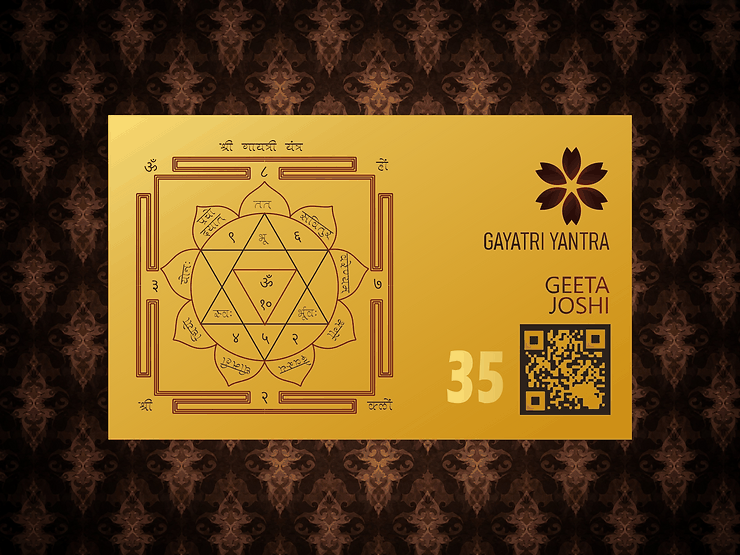
In tradition, the devotee who uses the Gayatri Yantra seeks a state of peace and harmony, happiness, inner satisfaction, and a positive outlook.
 House style v2 for bhagya.cards. A calm, devotional, premium image for an Indian almanac website with a dark theme.
Mood: quiet and reverent, warm, like the hush before an evening aarti.
Light: low and warm, from diyas, brass lamps or first sunlight; soft falloff into deep shadow; gentle gold
highlights; never flash, never flat daylight.
Palette, held across the whole frame: a deep night-maroon ground (#160D0C, #1F1311) deepening to oxblood (#2B100D,
#3A1714) in the shadows; burnished gold (#E2B55E, #EDBE6E) as the main highlight; saffron (#F2A24A) only in flame,
marigold or thread; warm cream (#F3E8DF) only in cloth, paper or marble; sindoor red and leaf green as small natural
accents. No blue, teal or purple cast, no neon, no pastels, no white backgrounds.
Materials: matte handmade paper, hand-beaten brass and copper, cotton and silk, old teak, stone; fine film grain.
No drawn ornament, diagram or pattern laid over the scene; no frames, no borders.
Composition: one clear subject; generous dark negative space; the subject inside the central 70% of the frame, so it
survives a 1.91:1 crop; eye level or slightly above; shallow depth of field.
People, only when the subject needs them: Indian, in modest traditional dress, natural and unposed; hands, profiles
and backs rather than faces turned to the camera; no likeness of any real or well-known person.
Respect: a deity appears only as a temple murti or a framed traditional painting, small in the frame, garlanded,
whole and upright, never on the floor and never near footwear; one tradition's iconography per image. Do not draw any
specific yantra, and do not draw a card or any printed product.
The image carries no text, letters, numerals, logos, watermarks or signatures anywhere.
Finish: photographic realism with a fine-art feel.
SUBJECT: Close on a polished copper lota of clean water on a teak stand in a home puja ghar in the early morning, a sprig of mango leaves standing in its mouth and a few tulsi leaves floating on the surface inside. A woman's fingers dip into the water, about to sprinkle a few drops, seen from the side, the droplets catching the gold light of a nearby brass diya. White jasmine and a small brass bowl of kumkum rest beside it. The background is deep and warm, with a soft window glow. Do not show: any yantra or geometric diagram, any object dipped in the water other than leaves, a card or printed product, any medicine or clinic, deity faces, any writing or symbols, faces.
FORMAT: 4:3 landscape, inline image.
Spiritual interests
Some old customs also turn to the Gayatri Yantra at times of hardship.
In these customs, a consecrated Gayatri Yantra is dipped in clean water, and this water is sprinkled on the person or building. It is a devotional custom and no substitute for professional care.
Goddess Gayatri
Goddess Gayatri is the deity of Gayatri Yantra's deity and Gayatri Mantra.
"Om Bhur Bhuvah Svah, Tat Savitur Varenyam, Bhargo Devasya Dhimahi, Dhiyo Yo Nah Prachodayat"
She is portrayed as having five heads and usually seated within a lotus.
The four heads of Gayatri represent the four Vedas, and the fifth one represents the almighty God. She is also associated in tradition with Lord Sun.